Ask which is better, an exercise bike or an elliptical, and you will usually get an answer about the machine. But the machine is rarely the deciding factor. What matters far more is the quality of effort each one lets you produce, and what that effort does to your cardiorespiratory fitness over weeks and years. Both are low-impact, both beat sitting still, and both can be useful. The evidence, though, points to a meaningful difference once your goal becomes maximum health from minimum time.
How an exercise bike and an elliptical actually differ
An exercise bike keeps you seated, with your legs driving a fixed circular path against a calibrated resistance. An elliptical has you standing, feet gliding along an oval track while your arms push and pull moving handles. The elliptical is a whole-body, weight-supported movement; the bike is a targeted, seated one. That single mechanical difference explains almost everything that follows, from how your heart responds to how hard you can realistically push.
Do they burn the same calories?
This is where the numbers on the console mislead people. Because the elliptical recruits your arms and trunk as well as your legs, it tends to raise your heart rate more than a bike at the same perceived effort. It is tempting to read a higher heart rate as more calories burned, but the two do not track neatly. When researchers matched effort by rating of perceived exertion, oxygen consumption and energy expenditure were similar across machines despite the higher heart rate on the whole-body device (Brown et al., 2010).
The same work also found that machine consoles overestimated energy expenditure compared with laboratory measurement. So a bigger calorie figure on the elliptical display does not mean more fat lost. Energy burn is driven by how hard you work and for how long, not by the badge on the frame. Judge a session by intensity and duration, not by the readout.
Which works your muscles harder?
The two machines load your legs differently. Surface electromyography, which measures the electrical activity of working muscles, shows distinct patterns: elliptical training produces greater rectus femoris activity, and greater co-activation of the rectus femoris with the hamstrings, than stationary cycling (Prosser et al., 2011). The elliptical also brings the upper body into play through the moving handles. Cycling, by contrast, delivers a more focused, repeatable leg-drive pattern.
Neither pattern is inherently superior. More muscles moving is not the same as a better training stimulus for your heart and lungs. What decides cardiorespiratory benefit is the intensity you can reach and sustain, and here the seated, stable, calibrated nature of the bike becomes an advantage.
Which is better for your joints?
Both machines are kind to your joints, which is much of their appeal. Neither involves the repeated impact of running, so both suit people carrying extra weight, returning from injury, or managing stiff knees and hips. The bike edges slightly ahead on stability, because you are supported by the saddle rather than balancing through a standing stride. If joint comfort is your first concern, either is a reasonable choice, and the bike is the more controlled of the two.
The factor that actually decides it: intensity and VO₂max
VO₂max, or maximal oxygen uptake, measures the most oxygen your body can use during intense exercise. It is one of the strongest predictors of long-term health there is. In a study of more than 120,000 adults, higher cardiorespiratory fitness was associated with lower all-cause mortality, with no observed ceiling to the benefit, and the fittest individuals had the lowest risk of dying (Mandsager et al., 2018). Improving your VO₂max is one of the most worthwhile things you can do for your healthspan, athlete or not.
The most efficient way to raise VO₂max is brief, genuinely hard effort, and this is where the bike separates itself. REHIT, or Reduced Exertion High-Intensity Interval Training, is built around two short all-out sprints inside a session of only around five minutes. In sedentary men and women, six weeks of REHIT improved VO₂max by roughly 15% in men and 12% in women, alongside a 28% rise in insulin sensitivity in the men (Metcalfe et al., 2012). A recent review concluded that REHIT is a feasible, time-efficient way to improve fitness and metabolic health for people who struggle to fit in longer training (Vollaard & Metcalfe, 2024).
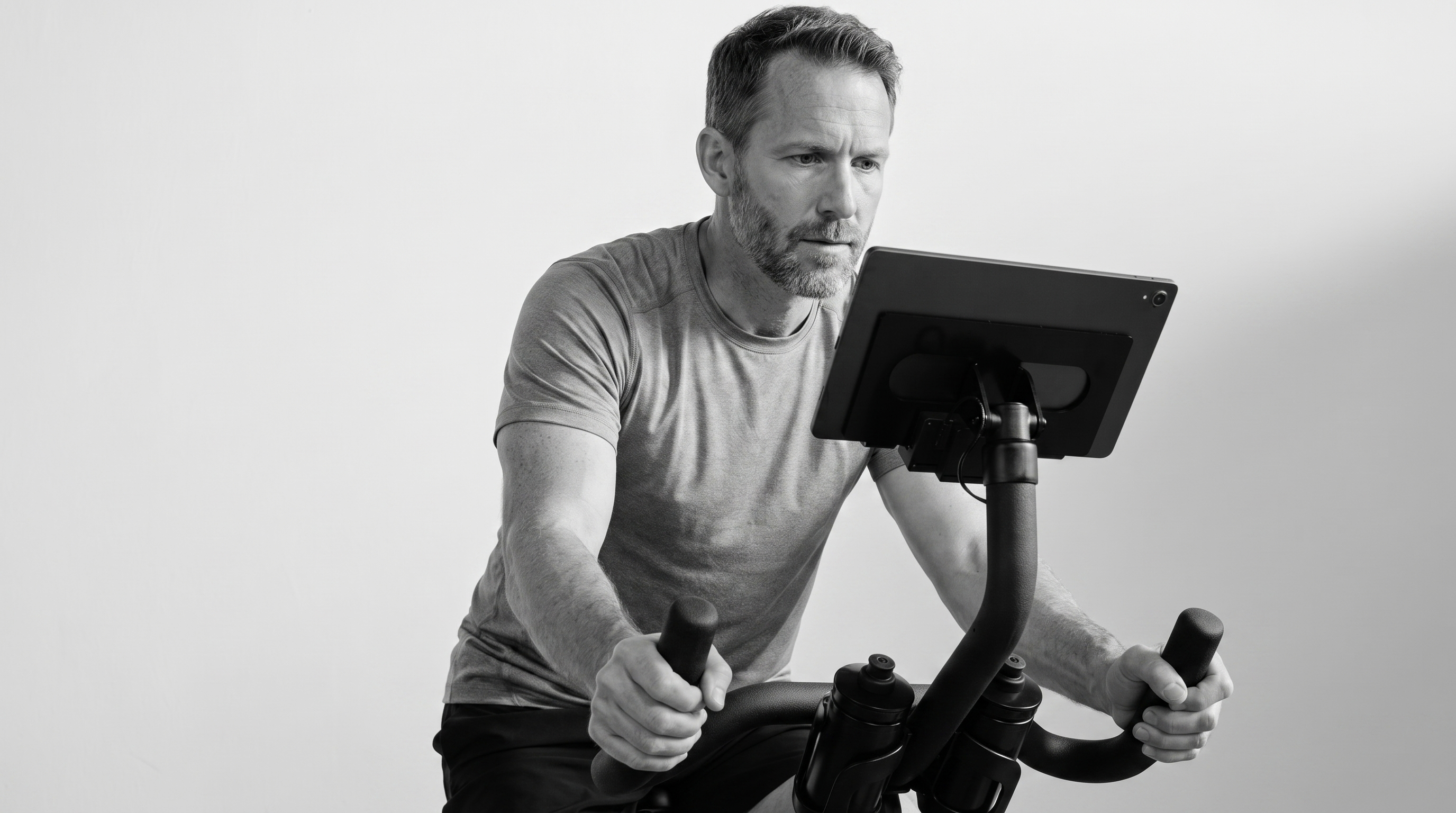
Crucially, that entire body of evidence was built on a cycle ergometer, and for good reason. A true all-out sprint depends on pushing against a known, precisely set resistance from a stable seated position, so that every session applies the same maximal stimulus. That is difficult to reproduce on an elliptical, where your effort is spread across a gliding, self-paced, whole-body movement and there is no fixed load to sprint against. The bike is not just one way to do this kind of training; it is the platform the science was validated on. This is also why CAROL uses a bike: it can measure your maximum and set each sprint’s resistance to it, which is what makes a five-minute session count.
So which should you choose?
If your priority is simply moving more with minimal joint strain, both machines will serve you, and the best one is the one you will actually use. If your priority is the biggest gain in cardiorespiratory fitness for the least time, the exercise bike has the stronger evidence base, because it enables the controlled, maximal sprints that drive VO₂max upward. The elliptical offers a pleasant, whole-body, low-impact workout; the bike offers a more precise dial on intensity, and intensity is what moves the numbers that matter for longevity.
The bottom line
Exercise bike versus elliptical is less a contest between two machines than a question of what you want from your training. For general, joint-friendly movement, either works, and consistency will matter more than your choice. But if you are training to raise your VO₂max and protect your long-term health in as little time as possible, the bike holds the advantage, because it is the tool that lets you reach and repeat true maximal effort. Choose the machine that fits your goal, then let the intensity, not the console, tell you whether the session counted.