When it comes to living longer, few habits are as well-evidenced as moving your body regularly. The harder questions are practical ones: how much do you actually need, what kind of activity counts, and does training harder buy you more years? At CAROL, we’re guided by science, so rather than trade in generalities, let’s look at what the evidence for exercise for longevity actually shows — and where it leaves room for how you, specifically, might train.
Why fitness is one of the strongest predictors of lifespan
Start with the outcome that matters most. In a study of 122,007 adults who completed a treadmill test, all-cause mortality fell steadily as fitness rose, with no observed upper limit to the benefit (Mandsager et al., 2018). Being in the least-fit group carried roughly a fivefold higher risk of death than being among the fittest — a gap comparable to, or greater than, the risk associated with smoking, diabetes or coronary artery disease. Notably, the benefit still held in people aged 70 and over.
The measure behind this is VO₂max, or maximal oxygen uptake — the maximum amount of oxygen your body can use during intense exercise. It is the clearest single number we have for cardiorespiratory fitness, and, importantly, it is modifiable. You are not stuck with the fitness you have today, and that is precisely why it deserves your attention.
How much exercise do you actually need?
Less than you might fear. Pooling data from 661,137 adults, researchers found that people who did some activity but fell short of the recommended weekly minimum still had a 20% lower risk of death than those who did none (Arem et al., 2015). Meeting the guideline — around 150 minutes of moderate or 75 minutes of vigorous activity a week — captured close to the maximum benefit, roughly a 39% reduction. Doing three to five times that added only a little more, and there was no sign of harm even at ten times the minimum.
This matters because the relationship is curvilinear: the steepest gains come as you move from doing nothing to doing something, and marked benefits appear at relatively modest volumes (Warburton & Bredin, 2017). Even walking counts. Across 15 cohorts and 47,471 adults, taking more daily steps was linked to progressively lower mortality, with the benefit levelling off at around 6,000–8,000 steps a day for over-60s and 8,000–10,000 for younger adults (Paluch et al., 2022). The reassuring headline is that you do not need to train like an athlete to move the needle — but the ceiling on benefit does reward building genuine fitness rather than simply staying busy.
Does the type of exercise matter, or just that you move?
Almost any movement helps, but intensity earns its place. In adults who did no formal exercise at all, short bursts of moderate-to-vigorous activity woven into daily life were associated with lower mortality and fewer major cardiovascular events (Ahmadi et al., 2023). Compared with the briefest efforts, bouts of one to three minutes carried about a third lower mortality risk, and bouts of five to ten minutes roughly halved it — and the shortest bouts only helped when a meaningful share of the effort was vigorous. In other words, it is not only that you move, but how hard, that shapes the result.
Why intensity is the efficient route to a longer life
If raising your VO₂max is the goal, intensity is the most time-efficient way to get there. A meta-analysis of 53 randomised controlled trials found that even short-interval (20–30 second), low-volume sessions of HIIT — high-intensity interval training — produced clear improvements in VO₂max, and described this approach as effective and time-efficient for the general population (Wen et al., 2019). Duration, in other words, is not the ingredient doing the work; effort is.
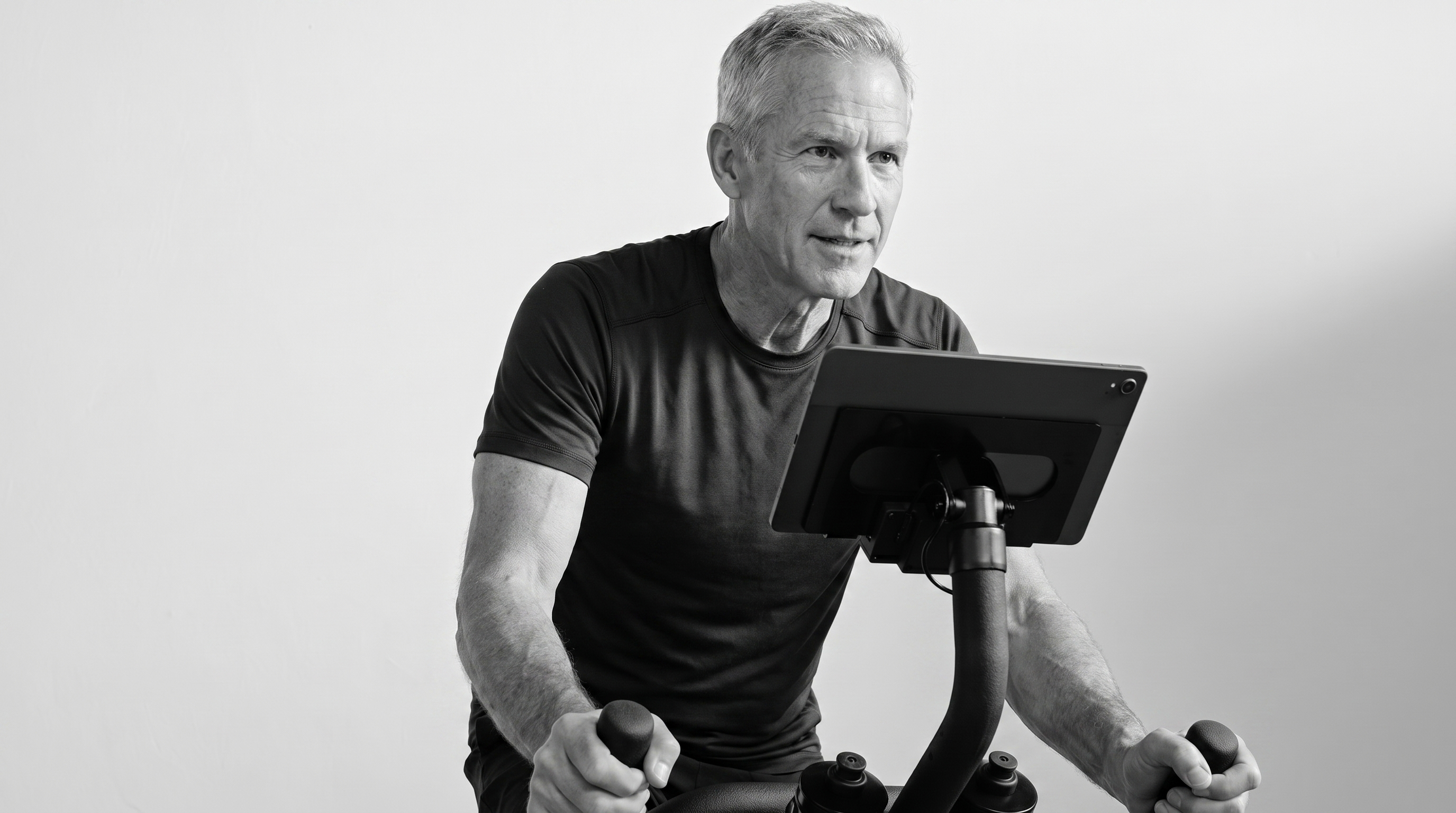
This is the principle behind REHIT (Reduced Exertion High-Intensity Interval Training), CAROL’s signature protocol: two 20-second all-out sprints inside a session lasting under ten minutes. The sprints are brief, but they are genuinely maximal — and it is that intensity, rather than the total time on the bike, that drives the adaptation. For anyone weighing exercise for longevity against a crowded schedule, the appeal is straightforward: a short, hard effort that targets the very marker most tightly bound to how long you live.
Sitting less is part of the equation
Longevity is not only about the minutes you train; it is also about the many hours around them. In an analysis of 79,503 adults, more time spent in moderate-to-vigorous activity was associated with lower mortality whether it displaced sleep, light activity or sitting, while more sedentary time carried higher risk — especially when it came at the expense of activity (Millard et al., 2021). The practical reading is simple: a short, intense session is a powerful anchor for your day, but breaking up long stretches of sitting adds to the effect rather than competing with it.
The benefit is not identical for everyone
The evidence also asks us to be honest about variation. In a study of 412,413 adults, women reached their maximum survival benefit at around 140 minutes of moderate-to-vigorous activity a week — roughly half the 300 minutes men needed — and gained more from each equivalent dose, with a 24% versus 15% lower risk of death (Ji et al., 2024). Starting point matters too: the steepest gains belong to those who begin least fit, where moving up even one fitness category is associated with a substantially lower risk (Mandsager et al., 2018). The people with the most to gain are often the ones who feel furthest from the start line, which is a hopeful message rather than a daunting one.
The bottom line
Exercise for longevity is not about punishing hours. The evidence points three ways at once: any movement beats none, meeting the weekly guideline captures most of the available benefit, and improving your fitness — your VO₂max — is the single most modifiable marker of how long you are likely to live. Intensity is what makes that efficient, because short, hard efforts can raise fitness in a fraction of the time steady-state work demands. Whatever you choose, the best programme remains the one you will genuinely come back to, week after week.