If you want to lose fat, cardio is usually the first tool you reach for. The harder question is what kind: long, steady sessions or short, hard ones. The fitness industry offers loud opinions on both sides. The research, based on articles retrieved from PubMed, is calmer — and more useful.
Here is what the evidence actually shows about cardio for fat loss: what works, how much you need, and why intensity may be a smarter lever than duration.
Does cardio reduce body fat?
Yes — measurably, though modestly. An umbrella review covering 79 randomised controlled trials and 2,474 adults found that interval training reduced body fat percentage by 1.50 percentage points compared with not exercising, and by a further 0.77 points compared with traditional moderate-intensity steady-state cardio (Poon et al., 2024). Reductions in fat mass, visceral fat, and abdominal fat followed the same pattern.
An earlier meta-analysis of 39 studies in 617 adults reached the same conclusion: high-intensity interval training significantly reduced total, abdominal, and visceral fat mass, in both men and women (Maillard et al., 2018).
The honest caveat: cardio alone, over a few months, will not transform your body composition. A systematic review comparing interval training with steady-state cardio found both reduced body fat by roughly 1.3–1.5 percentage points — and described neither as clinically meaningful on its own over the short term (Keating et al., 2017). Fat loss is driven primarily by an energy deficit, which means your nutrition does the heavy lifting. Cardio’s role is to deepen that deficit, protect your cardiorespiratory fitness while you lose weight, and target the fat that matters most for your health.
Intensity or duration: which matters more?
When total work is matched, hard intervals and long steady sessions produce broadly similar fat loss (Keating et al., 2017). The difference is the time it takes to do that work.
A 2026 network meta-analysis of 18 randomised trials in adults with overweight or obesity compared different weekly doses of interval and continuous training over 8–16 weeks. Interval training of 75 minutes or more per week ranked first for almost every outcome: body fat percentage fell by 3.05 percentage points, waist circumference by 4.82 cm, and VO₂max — maximal oxygen uptake, the best single measure of your cardiorespiratory fitness — rose by 5.94 ml/kg/min compared with controls (Deng et al., 2026). Continuous training needed 150 minutes or more per week to compete.
In practical terms: intensity buys back time. You can reach a similar — sometimes better — outcome in roughly half the weekly minutes.
Why hard intervals punch above their weight
Part of the answer is what happens after you stop pedalling. Your body continues to consume oxygen at an elevated rate while it restores itself — a phenomenon called excess post-exercise oxygen consumption, or EPOC. In a controlled comparison where both workouts burned the same ~300 kcal, interval exercise produced significantly higher EPOC in the 30 minutes afterwards (66 kcal versus 54 kcal), and a greater share of that post-exercise energy came from fat (Jiang et al., 2024).
The per-session difference is small. But repeated several times a week, every week, it compounds — and it comes free with the harder effort, not with extra training time.
The fat you cannot see matters most
Most people judge fat loss by the mirror and the scales. Your health is more interested in visceral fat — the fat stored around your organs — and the evidence suggests cardio is particularly good at reaching it. Interval training significantly reduced visceral adipose tissue compared with controls across the trials reviewed (Poon et al., 2024; Maillard et al., 2018).
The same applies to epicardial fat, the depot that sits directly on your heart and is linked to cardiovascular risk. A meta-analysis of ten randomised trials in 521 adults found that exercise alone — with no dietary intervention — reduced epicardial adipose tissue with a large effect size (Saco-Ledo et al., 2020). You will not see these changes in the mirror. Your cardiovascular system will register them all the same.
How little can you do?
Less than you might think. In the umbrella review above, the fat-loss benefits of interval training were most pronounced in protocols using cycling and in low-volume formats — less than 15 minutes of high-intensity work per session (Poon et al., 2024). Shorter and harder, on a bike, is exactly where the evidence points.
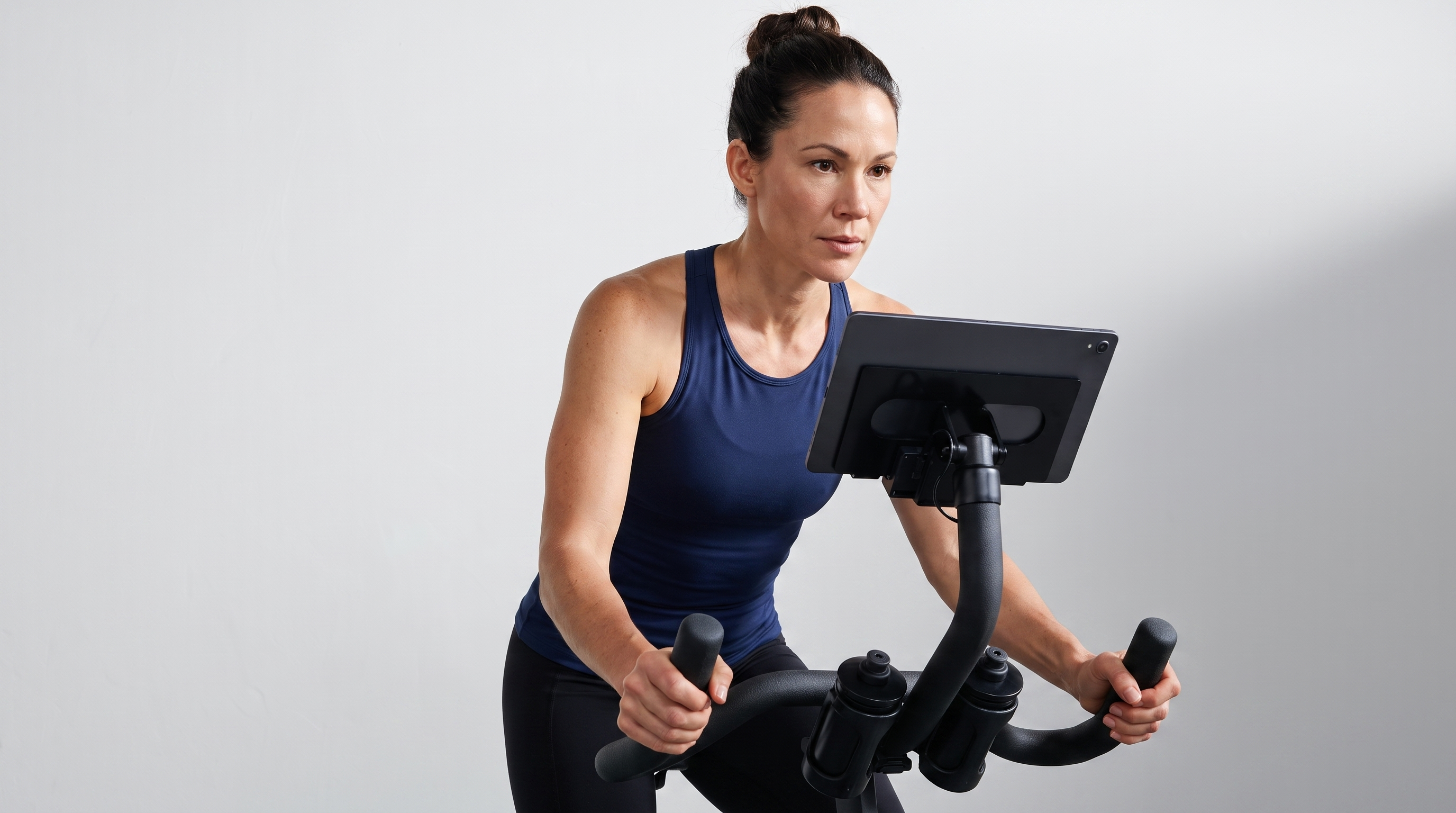
This is the territory of REHIT — Reduced Exertion High-Intensity Interval Training — CAROL’s signature workout: two 20-second all-out sprints inside a ride of around five minutes. REHIT compresses the intensity signal into the smallest practical dose. In a recent independent trial, riders following CAROL’s REHIT programme improved VO₂peak by 16% in six weeks. And because the sessions are short, they are far easier to repeat week after week — which is where fat loss is actually won. The best protocol is the one you will still be doing in six months.
Does this still apply later in life?
It does. In a study of adults in their eighties — average age 81, most with conditions such as hypertension or osteoarthritis — just four weeks of supervised interval training on a bike reduced total fat mass by 0.8 kg while slightly increasing fat-free mass, with no adverse events reported (Blackwell et al., 2021). Intensity is relative to your own capacity. An all-out sprint at 80 looks different from one at 30, but your body adapts to both.
As with any training programme, responses vary between individuals — which is why we recommend REHIT is individualised for each person, and why CAROL calibrates your sprints to you.
The bottom line
Cardio works for fat loss — modestly on the scales, more impressively where it counts: visceral and heart-adjacent fat, waist circumference, and VO₂max. When total work is matched, intervals and steady-state deliver similar fat loss, but intervals deliver it in roughly half the time, with a small post-exercise burn on top.
So the practical answer to “what is the best cardio for fat loss?” is not a particular machine or a magic heart-rate zone. It is the highest intensity you can sustain safely, in a format short enough that you will repeat it consistently — anchored to sensible nutrition. That is the entire logic behind REHIT: minimum dose, maximum signal, every day you can manage it.